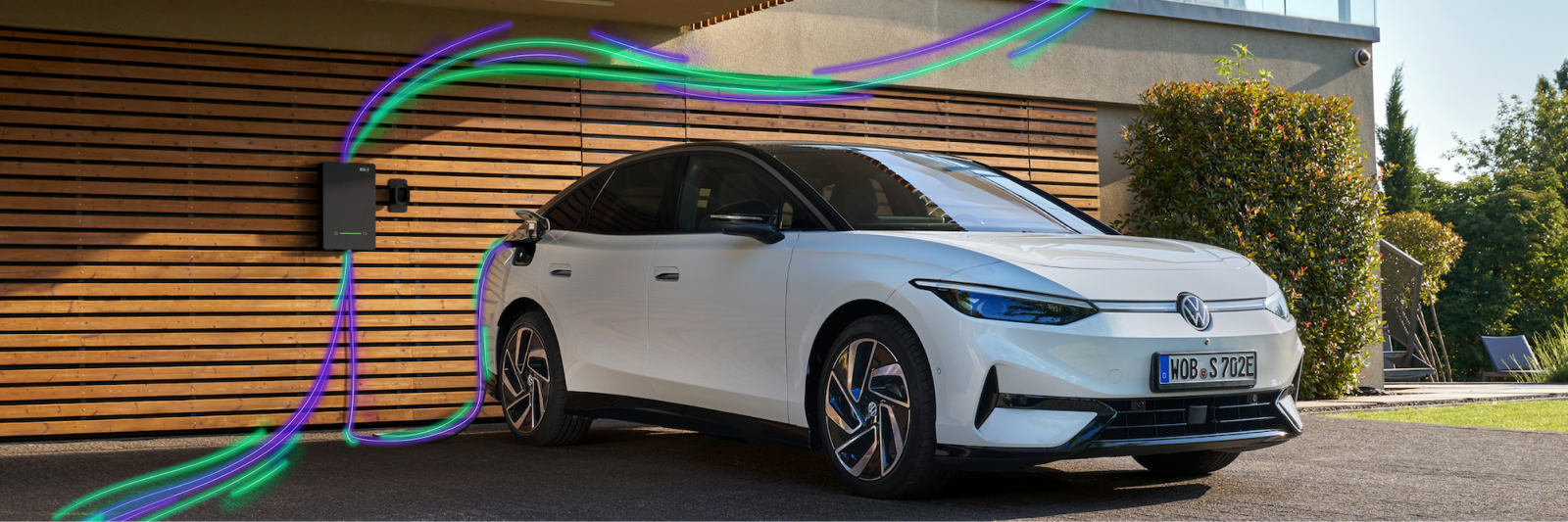
Vehicle-to-Grid: How electric vehicles are becoming a key pillar of the energy transition
The energy transition is creating new challenges for the power system. Renewable energy does not generate electricity consistently, while demand continues to rise due to electric mobility. Vehicle-to-Grid (V2G) addresses exactly this issue and turns electric vehicles into part of the solution. This article explains what V2G is and how EVs become active energy storage systems.
In the future, electric mobility will actively contribute to stabilising the power grid and enabling a carbon-neutral energy supply – and EV drivers may even benefit financially. In this context, EV batteries become flexible, mobile energy storage systems that can not only store electricity but also feed it back into the grid when needed. This dynamic interaction between mobility and energy is made possible by Vehicle-to-Grid technology.
What is Vehicle-to-Grid?
Vehicle-to-Grid, often abbreviated as V2G, means that an electric vehicle can not only draw electricity from the grid but also feed it back into the power system.
An electric car thereby becomes a mobile battery storage unit:
Charging: the vehicle draws electricity from the grid
Discharging: the vehicle feeds electricity back into the grid
This bidirectional energy flow is enabled by special charging infrastructure and intelligent control systems. Once the vehicle is connected to suitable charging equipment, energy can flow in both directions. This capability is known as bidirectional charging. The core idea is simple: batteries already present in electric vehicles are additionally used as part of the energy system.
Difference: Vehicle-to-Grid vs. Vehicle-to-Home
Vehicle-to-Grid (V2G): electricity is fed back into the power gr
Vehicle-to-Home (V2H): electricity is used to power a household
Vehicle-to-Home (V2H) refers to using an electric vehicle as an energy storage system for a home. The vehicle is connected to the household electrical system via a bidirectional charger and can supply stored energy from its battery to the home when needed. This allows surplus solar energy generated during the day to be used in the evening when demand is higher. In this way, households can optimizse self-consumption and reduce energy costs.
Why Vehicle-to-Grid is important
Vehicle-to-Grid addresses a key challenge of the energy transition: the lack of flexibility in the power system.
Renewable energy is not always generated when it is needed. Solar energy is mainly produced during the day, while electricity demand is often highest in the evening. Wind power can generate electricity at night, when demand is low. V2G helps bridge this gap.
Electric vehicles store excess energy and feed it back into the grid when required. This stabilizes the power system and enables more efficient use of renewable energy.
How does Vehicle-to-Grid work?
Vehicle-to-Grid operates through the interaction of the vehicle, charging infrastructure, and digital control systems. First, an electric vehicle must support bidirectional charging. This allows electricity to flow both into and out of the EV’s battery. In addition, an intelligent management system is required to decide when energy should be stored or supplied back.
These decisions are based on several factors, including grid conditions, electricity prices, and user preferences. A typical example is a predefined minimum state of charge, ensuring that the vehicle is always ready to drive.
In the background, many vehicles are often aggregated. This is done via digital platforms, enabling coordinated energy feed-in to the grid. In this way, thousands of vehicles can form a virtual power plant.
What technical requirements are needed for Vehicle-to-Grid?
Vehicle-to-Grid requires specific technical capabilities in both vehicles and infrastructure. The most important requirement is bidirectional charging capability. This means the EV must be able not only to draw power from the grid but also to feed it back. Both the vehicle and the charging station must support this function.
In addition, appropriate metering infrastructure is required to accurately record and bill energy flows. This is where smart meters come into play. Communication and control systems are also needed to coordinate and automate energy exchange between the vehicle, charger, and power grid.
Key components for V2G:
Bidirectional electric vehicle
The EV must be able not only to charge but also to feed electricity back into the grid.
Bidirectional charging infrastructure
A specialised charger or DC charging station enables energy flow in both directions.
Smart meter
A digital electricity meter that records and transmits energy consumption automatically at short intervals.
Energy management system
It automatically controls when charging or discharging occurs, taking into account electricity prices, grid load, and the desired state of charge.
Communication standards
Standardised protocols such as ISO 15118 ensure communication between the vehicle, charger, and grid.
Aggregator or platform
Multiple vehicles are bundled into a virtual power plant to participate in energy markets.
Benefits of Vehicle-to-Grid
Vehicle-to-Grid creates direct value for different stakeholders in the energy system.
For users, it enables their electric vehicle to be used economically. Energy is not only consumed but can also be provided back to the system which can generate additional income.
For energy suppliers, V2G provides a new form of flexibility. Instead of relying solely on large power plants or stationary storage systems, existing vehicle batteries can be used.
For the overall power system, stability improves. Fluctuations caused by renewable energy can be better balanced, reducing the need for fossil fuel powered power plants.
Challenges
Vehicle-to-Grid is technologically promising but still faces several challenges. One common concern is battery lifespan. Additional charging cycles may theoretically increase wear. However, modern control systems minimise this impact by optimising charging behaviour.
Another issue is infrastructure. Bidirectional chargers are not yet widely available, and standards and interfaces are still evolving. Regulatory frameworks also play a key role, as many markets have not yet fully defined how distributed storage can participate in energy markets and be compensated.
Finally, user acceptance is crucial. Systems must be simple, reliable, and transparent.
Future outlook
V2G will become increasingly relevant as electric vehicles become more widespread. With every additional vehicle, the available storage capacity grows. Millions of EVs could together form one of the largest energy storage systems in the world.
In the long term, V2G will become part of an intelligent energy system where electricity, mobility, and digital platforms are closely integrated. Special electricity tariffs and automated control systems will support this development, fundamentally changing the role of the electric vehicle – from transport device to active energy infrastructure component.
Conclusion: Why V2G is a real game changer
Vehicle-to-Grid connects electric mobility and the energy transition in a new way. Electric vehicles are no longer used only for transportation but also for storing and supplying energy.
The technology helps integrate renewable energy more efficiently and stabilise the power grid. At the same time, it creates new opportunities for users and energy providers. Vehicle-to-Grid is therefore a key building block for a sustainable and flexible energy system.
Key takeaways:
Electric vehicles become energy storage systems
Power grids become more stable and efficient
Users can actively participate in energy markets
V2G significantly accelerates the energy transition