
The future of the energy market: What role does Vehicle-to-Grid play?
What if your EV could do more than just consume electricity and also help stabilize the power grid? That is exactly what Vehicle-to-Grid (V2G) makes possible. In this article, you will learn how bidirectional charging works, why flexibility is becoming increasingly important in the electricity market, and what potential millions of electric vehicles hold for the energy transition.
The energy transition is changing not only how we generate electricity, but also how we use it. As the share of renewable energy grows, the power system is becoming increasingly flexible: wind and solar power are not available in the same quantities at all times. At the same time, e-mobility is driving up electricity demand. The key question, therefore, is: How can we intelligently balance supply and demand?
One of the most promising answers is Vehicle-to-Grid (V2G). With V2G, electric vehicles are not only charged but can also feed electricity back into the grid when needed. The car thus evolves from being a consumer into an active part of the energy system.
Why flexibility matters now
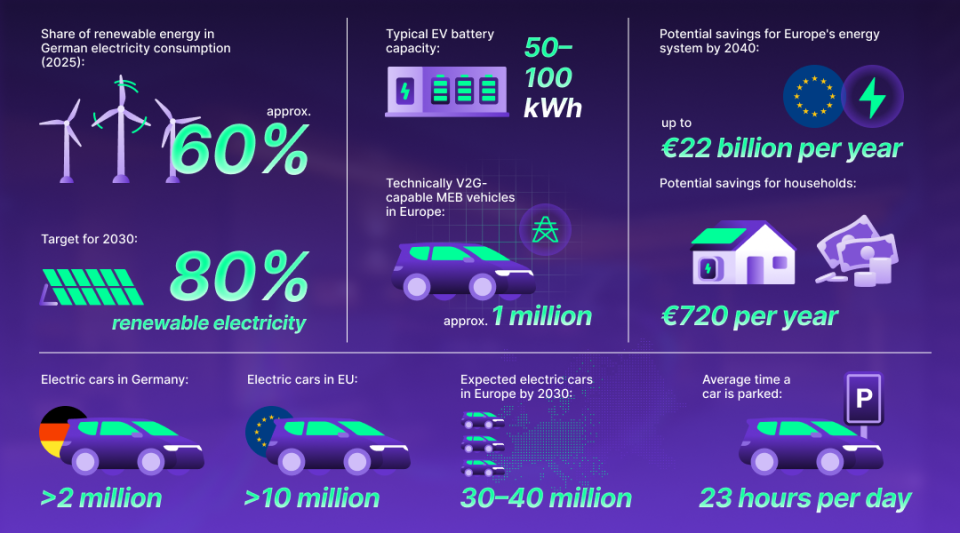
Germany is in the midst of transforming its energy system. In 2025, about 60% of Germany's gross electricity consumption already came from renewable energy sources, with their share significantly higher on some days. The political target is therefore ambitious: by 2030, at least 80% of electricity is to come from renewable sources.
However, every additional wind farm and new solar installation also increases the need for flexibility. When particularly large amounts of solar power are generated at midday or strong winds happen at night, this electricity either needs to be stored or used immediately.
At the end of 2024, Germany had around 100 gigawatts of installed solar capacity. In the same year, solar energy systems generated around 72.2 terawatt-hours of power. By 2030, installed solar capacity is expected to grow to 215 gigawatts. At the same time, 115 gigawatts of onshore wind capacity are targeted. This means that periods of surplus electricity will become increasingly common in the future.
Electric vehicles: Europe's largest untapped battery
At the same time, the number of EVs is growing rapidly.
More than two million battery-electric vehicles (BEVs) are already on German roads. Across Europe, the number has now surpassed 10 million.
However, the real potential will only become apparent in the years ahead:
The European Commission expects 30 to 40 million electric cars by 2030.
Every modern electric vehicle typically has a battery with a storage capacity of 50 to 100 kWh.
Even if only a portion of these vehicles were used bidirectionally, they could form a virtual large-scale storage system with several hundred gigawatt-hours of capacity.
For comparison: Germany's currently installed large-scale battery storage systems collectively have only a fraction of this storage capacity.
Why the car is the perfect battery
An average car is parked and unused for around 23 hours a day. This time can be used to help stabilize the power system.
Vehicle-to-Grid works in a remarkably simple way:
Überschüssige erneuerbare Energie aus dem Stromnetz kann im Fahrzeug gespeichert werden.
When electricity demand rises later, a small portion of this energy can be fed back into the grid.
The driver always retains an individually defined minimum state of charge.
The vehicle is therefore only used when doing so does not compromise the owner's convenience.
Enormous economic potential
Numerous studies demonstrate that Vehicle-to-Grid is not only technically feasible but also economically viable. An analysis by Fraunhofer ISI found that bidirectional charging could save the European energy system up to €22 billion per year by 2040.
Vehicle owners can also benefit: depending on the tariff model and individual charging behavior, intelligent charging and providing flexibility can generate several hundred euros in savings or additional value per year. Initial commercial offerings indicate potential savings of up to around €720 annually.
More renewable energy – without additional grid expansion?
Vehicle-to-Grid can do more than reduce costs. It can also help to:
reduce peak loads
relieve local power grids
better integrate renewable energy
Studies show that intelligent flexibility can significantly reduce the need for grid expansion and stationary battery storage. This can lower the overall costs of the energy transition in the long term.
The technical prerequisites are developing rapidly. Numerous electric vehicles already support bidirectional charging today. On the Volkswagen Group's MEB platform alone, around one million vehicles in Europe are technically prepared for bidirectional charging. Combined with smart wallboxes, smart meters and dynamic electricity tariffs, the necessary ecosystem is emerging step by step.
From electric car to energy partner
Vehicle-to-Grid fundamentally changes the role of the electric car. Instead of simply consuming electricity, the vehicle becomes an active part of the energy system. Millions of connected batteries could help make optimal use of renewable energy, stabilize power grids and reduce energy costs.
As renewable energy continues to expand, flexibility will become one of the most important resources in the electricity market. Electric vehicles are ideally suited for this role – because the necessary battery is already parked right outside our homes.
Vehicle-to-Grid is therefore far more than a new charging technology. It is a key building block for a climate-neutral, stable and economically viable energy system of the future.
Key figures at a glance:
Sign up now with no obligation and be among the first to benefit from this new way of charging. We will let you know as soon as the offer becomes available.